
Why Our Parents and Grandparents Left the Farm

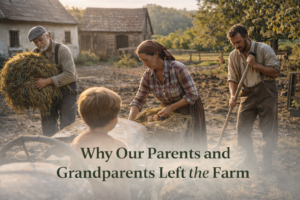
To understand today’s renewed interest in homesteading across Europe, it’s essential to understand why so many left it in the first place. For earlier generations, farming was not a lifestyle choice, it was survival. It meant long days of physical labour, unpredictable income, and total dependence on weather and seasonal cycles. There were few guarantees, limited social protections, and little recognition for the work being done.
As industrialisation expanded across the European Union, cities offered what farms often could not: stable wages, predictable working hours, access to education and healthcare, and developing infrastructure. Mechanisation reduced the need for manual labour, small farms struggled to compete, and profit margins continued to shrink. Many parents actively encouraged their children to pursue “better” careers, ones that did not depend on rainfall, market volatility, or physical endurance.
Electricity, plumbing, and modern utilities arrived late in many rural European regions. Urban life, by contrast, promised comfort, convenience, and upward mobility. Leaving the farm was not abandoning tradition; it was an act of responsibility and hope for the next generation.
Responses